BY COURTNEY GAILLARD
THE CHRONICLE
Sept. 12, 2003
 |
| Crystal Thornton |
Crystal Thornton is used to the stares she receives when she’s out in public. Viewers often recognize the Fox 8 news anchor from her nightly newscast. But Thornton knows that not all of the stares she receives are looks of recognition. Many times the onlookers are trying to figure out exactly who and what Thornton is.
“I think every time someone asks you, ‘Can I ask you a question?’ you know what that question is going to be before they even ask it. Sometimes I go ahead and say, ‘I’m black,'” said Thornton, who is originally from Topeka, Kan.
At times when she is questioned about her ethnicity, Thornton said, she will run down the list of races that make up her background because some people are not satisfied with her simply saying that she is black.
“I’m very proud of all of my heritage, very proud,” said Thornton, whose parents are of multiracial ancestry ranging from black, white to Native American. Thornton said her lineage can be traced back to an African slave and to a Confederate general. Her mother prefers to refer to herself as an American as opposed to saying black or African-American because she believes that best represents who she is.
“Because of her upbringing, it’s not that she doesn’t want to admit that she has African-American blood, but it’s just they went through so much. It was hard on them, and it was a different generation,” Thornton said.
Thornton’s mother and grandmother were plaintiffs in the landmark civil rights case Brown vs. the Board of Education, which desegregated public schools.
Thornton, a former captain of her high school cheerleading squad and homecoming queen, is well aware that those and other opportunities since were afforded to her thanks to her family’s involvement in that class action suit.
I was so involved in school, academically as well as extracurricularly, and that was partially due to the sacrifices that my mother and my grandmother made. That has always made me proud,” Thornton said. “I had an All-American high school experience. Those were good years in school.”
But there were some tough years for Thornton, particularly when she was younger. As a child, Thornton said, her long hair and light-colored eyes were often the focus of name-calling and teasing by other kids on the playground.
“My mother exposed me to more as a young child. She put me in dance classes; she put me in pageants; she did all of those things, I think, to try and help to boost my self-esteem that kids were trying to pull away from me because of the way I looked,” Thornton said.
As cruel as they were at times, Thornton believes the unfavorable treatment she received from her young peers was a sign of what many of them learned at home. Growing up, Thornton said, she tried to fight the way that she looked and the stereotypes attached to her appearance.
Fighting stereotypes
 |
| Martha Clavelle |
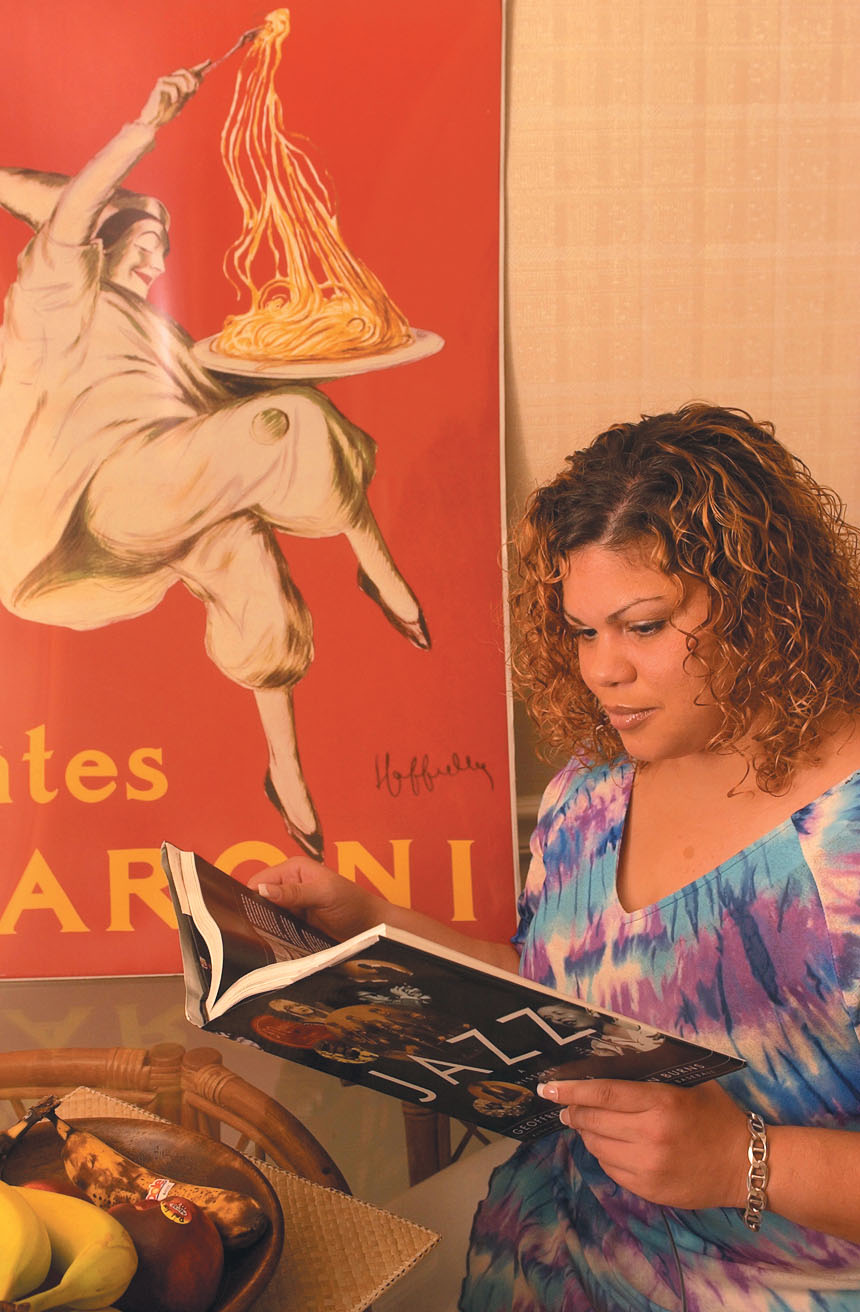
Martha Clavelle has been fighting stereotypes since the day the California native was born in 1972 to a white mother and black father. As her mother cradled her new baby in her arms, the woman in the bed next to her admired the “beautiful” bundle of joy too. Unaware that the father of the baby was black, the woman said to Clavelle’s mother, “I hear there’s a nigger baby (in the hospital).”
“This woman went on and on about this “nigger baby” not realizing that she was talking about me. My dad was able to get off work. He came in to the hospital and instantly this woman knew,” Clavelle said. Although angered by the woman’s comments, Clavelle’s mother was scared and unsure of how to react. “She (the woman who made the remark) freaked out and asked to be transferred out of the room.”
The Clavelle family was a large, tight-knit group made up of Clavelle and her four siblings along with five cousins who were also biracial. All of the children grew up together and attended school together. The household – frequently inhabited by 10 children at a time – was an orderly one ruled by her father’s iron fists.
“My father’s philosophy was that people will already look at you like you’re a monkey, so we don’t want you (to misbehave),” said Clavelle, who was raised by both of her parents to identify themselves as black. Her parents believed that people would always see and treat them as black, not biracial.
“We went to predominantly white schools, and people knew my dad was black. We were ‘niggers’ in their minds,” Clavelle said. “I grew up fighting every single day because regardless of how light I was, I was still a ‘nigger,’ and I had to defend myself and my father.
Keith Maddox, assistant professor of psychology at Tufts University, has studied skin tone bias in America. He believes that people are still susceptible to racial stereotypes based on their appearance regardless of how they identify ethnically.
“The more people see blackness in you, physically the more they’re going to associate you with that particular group and the stereotypes they have about that group. On the other hand, people who are seen as being less black physically are going to be attributed stereotypes less and less according to the way blacks are stereotyped,” Maddox said. “I think that everything that you see today is a consequence of what happened (during slavery) in the ways not only blacks thought about one another but also the ways that whites thought about blacks,” Maddox said. “It wasn’t just blacks who saw distinctions about dark and light skins, it was whites who saw those distinctions, and I think those distinctions trickled down and became exaggerated in the black community.”
Jungle fever
When Thornton and her husband, Ronald, who is dark-skinned, returned to North Carolina after living in Texas, they had to fight the preconceived notions and prejudices of some people who assumed the two were an interracial couple, she said.
 |
| Crystal and Ronald Thornton |
“People had said) openly to us, ‘He’s got Jungle Fever, and that angered me. There are times when I can tolerate it, and then there are times when it gets to be too much,” Thornton said. “We’ve gone to restaurants, which were predominantly white and walked in and people turned and looked. I assumed it’s because I’m on the news and people recognize me.”
The two were married more than 12 years ago before he was deployed to the Persian Gulf. Her husband, who was recently promoted to a U.S. Marine Corps major, has been stationed around the country from Oregon to Texas to North Carolina, where, she said, they have encountered a variety of reactions from folks.
“When I came back to North Carolina last year, those old experiences raised their ugly head again. I’d forgotten that people look at a person’s outward appearance because I’d been in so many areas of the country where people looked at the person, not their color necessarily,” Thornton said.
Thornton recalled an incident many years ago in Eastern North Carolina when she and her husband went into a restaurant for dinner and were met by stares from the entire restaurant. They became so angered to the point where they considered leaving the eating establishment. After waiting a long time to be served, they finished their meals despite the cold reception. Thornton said that experience reminded her of the prejudice that she experienced as a child.
“Many times we go to country clubs and Caucasian people would ask if my husband was my bodyguard,” Thornton said. “I am so naive to that kind of stuff because my life has been, for the most part since I’ve been in television, one of acceptance, at least on the surface.”
Clavelle and her family grew accustomed to icy reactions from people just about everywhere they went when she was growing up. Members of the Clavelle family were regulars at a Chinese restaurant in their hometown, which was owned by another family whom Clavelle’s father knew well. She recalls one particular time the family sat down to eat, much to the dismay of a white family at a nearby table.
“This (white) family became more and more irate and (the father) stood up, threw his napkin in his plate and said, ‘This is just disgusting, and I will not sit here and watch this. This is a sin and it is absurd.’ He was talking about our family,” Clavelle said.
Dining out wasn’t the only place where Clavelle and her family were made to feel as if they were on display like a circus act. She said simple outings such as trips to the grocery store were almost always open invitations for strangers to stop and “inspect” her and her siblings.
“People would stop my mother and ask, ‘Whose children are you baby-sitting?’ and my mother would tell them that ‘These are my black children,'” Clavelle said. After such episodes, said Clavelle, her parents would tell the children that people were just “looking for their tails” to make light of the uncomfortable situation.
Growing up biracial was normal for Clavelle and her family. The only time her background became a problem, said Clavelle, was when other people made it a problem or felt threatened by her.
“It took me a long time to understand that people are who they are, not because of their color, but because of who they are – their character, their beliefs,” Clavelle said.
Clavelle said she didn’t become “the light-skinned girl” until she got to college. One of her closest college friends was as dark as she was light and once told her that the two never would have been friends had they lived in her urban hometown because people never would have accepted the two because of their contrasting complexions.
“I got to college and I started hearing that I had ‘good hair.’ My mother used to always say that good hair is hair that is cleaned and combed,” said Clavelle, who has a degree in black studies and was very active in black organizations on her college campus. She said she gravitated toward her fellow black students not to prove herself, but because that is whom she felt most comfortable around. Clavelle said that she also relates better to black men where dating is concerned. Dating experiences outside of black men have not proven to be very successful for her.
“When people became envious of me or when they had a problem with me, that’s when they threw my ethnic background up and when it became an issue,” said Clavelle. “College was hard.”
Culture shock
Moving from Northern California to North Carolina two years ago was a culture shock for Clavelle, who was accustomed to living in a multicultural community. Instead of being greeted by the welcome wagon the day she moved to Winston-Salem, Clavelle encountered some hostile natives in the parking lot of a grocery store.
I’m walking in the parking lot getting ready to cross the street and enter the store and up pulls a car with four black women in it. They pulled up right in front of me to the point where I had to stop so I wouldn’t get run over, and I hear someone yell, ‘I know this high yellow bitch better not walk in front of me,'” said Clavelle. “What was that about? They didn’t know me. I had just moved here.”
While Clavelle invites the opportunity to live in another part of the country and experience a new culture, she recognizes the uphill battle ahead of her. Adjusting to Southern living has meant fielding questions about her ethnic background on a regular basis and being mistaken for Puerto Rican.
She works as a counselor to disturbed teenagers at The Children’s Home. She enjoys the opportunity to work as an advocate for others because she feels as if she’s been one for herself all of her life.
I’m sound in being a black woman and feeling confidant in that, but I also know that there are a lot of nuances that I haven’t experienced and don’t understand,” said Clavelle. “I made the choice to embrace my culture and my heritage, and I love the fact that I am a black woman.”
Thornton is equally proud of all that makes up her heritage. She too believes a person’s color does not dictate what or who they are, and so she makes a point to see people for who they are beyond the color of their skin.
Ethnicity doesn’t define who you are. What defines you is your heart; that’s the bottom line,” said Thornton. “If your heart is not right or if you don’t have a passion for people or for your neighbor, then it doesn’t matter.”
Thornton doesn’t consider herself to be a celebrity because of her profession. Rather, she sees her job as community service. She explained that she has lost jobs in television because she did not “look black enough.”
“People relate to who they’re comfortable with, and if they don’t see someone that they feel represents them on the air, then sometimes they’ll turn to another station,” Thornton said. “I believe in my heart that I have gotten every position because of my ability, my strong personality and because I’m a talented journalist.”
Thornton truly believes that most of the people who stop her and inquire about “what she is” are sincerely curious and mean no harm. She hopes that people will learn to never judge a book by its cover but rather by what’s on the inside. Thornton shines on the television and off. When she is not delivering the news to viewers around the Piedmont Triad, she enjoys singing gospel. Thornton has sung with popular gospel acts such as The Winans, The Clark Sisters and Donnie McClurkin.
“I guess when you look at me, I hope that people see a light that is shining brighter than my complexion,” Thornton said.
 Light and All Write