Black Like Me
Reporter will tell tales of light-skinned African-Americans in series of stories
BY COURTNEY GAILLARD
THE CHRONICLE
August 28, 2003
I am black.
But I am frequently mistaken for white. It’s not unusual for me to be stopped by strangers and asked, “What are you?” or “Where are you from?” And people will ask you these types of questions in the strangest places – at a drive-through window, in a department store, at a bar.
Recently, I was once again reminded just how low my signal falls on the racial radar.
“Is she the only white girl in the wedding?” asked the (white) wedding coordinator of a Baptist church in Charlotte.
She was referring to me – the maid of honor – during a recent wedding rehearsal.
“She is not white!” replied members of the rest of the wedding party – all of whom were black and quickly came to my defense.
The wedding coordinator knew my name, so I do fault her for posing such a presumptuous question out loud. Her point was to tell the flower girl to remember to stand next to the “white girl.”
After the wedding coordinator’s eyes widened and her mouth fell open – the usual reaction by most upon finding out that I am not white – she responded, “Well she’s the closest thing to Caucasian that I see in the room.”
To which I responded, “Well you haven’t seen the rest of my family, so get ready.”
Quickly the other bridesmaids and the hostesses came to my side in attempts to console me; however, I explained to them that this was yet another case of my mistaken identity.
In my family, we run the gamut as far as color is concerned. We come in every shade from yellow, olive, honey, caramel to brown. My mother is biracial: Her father was black and her mother was white.
(She prefers the term “biracial” over “mixed” for fear of sounding like an ingredient in a recipe.) My father is black and fair-skinned. Both of his parents were of mixed ancestry as well. So naturally I and my three siblings are light-skinned.
And for our family, the racial potpourri continues. Both of my older brothers have married across racial lines, and my four fair-skinned nieces and nephew are proof that the Gaillard genes are strong. I often wonder how they will be received by the world around them as the grow up. I pray that the children on the playground won’t be too cruel to them because they “look different.” Children’s taunts and teases can sting almost as much as any insult spoken by an adult.
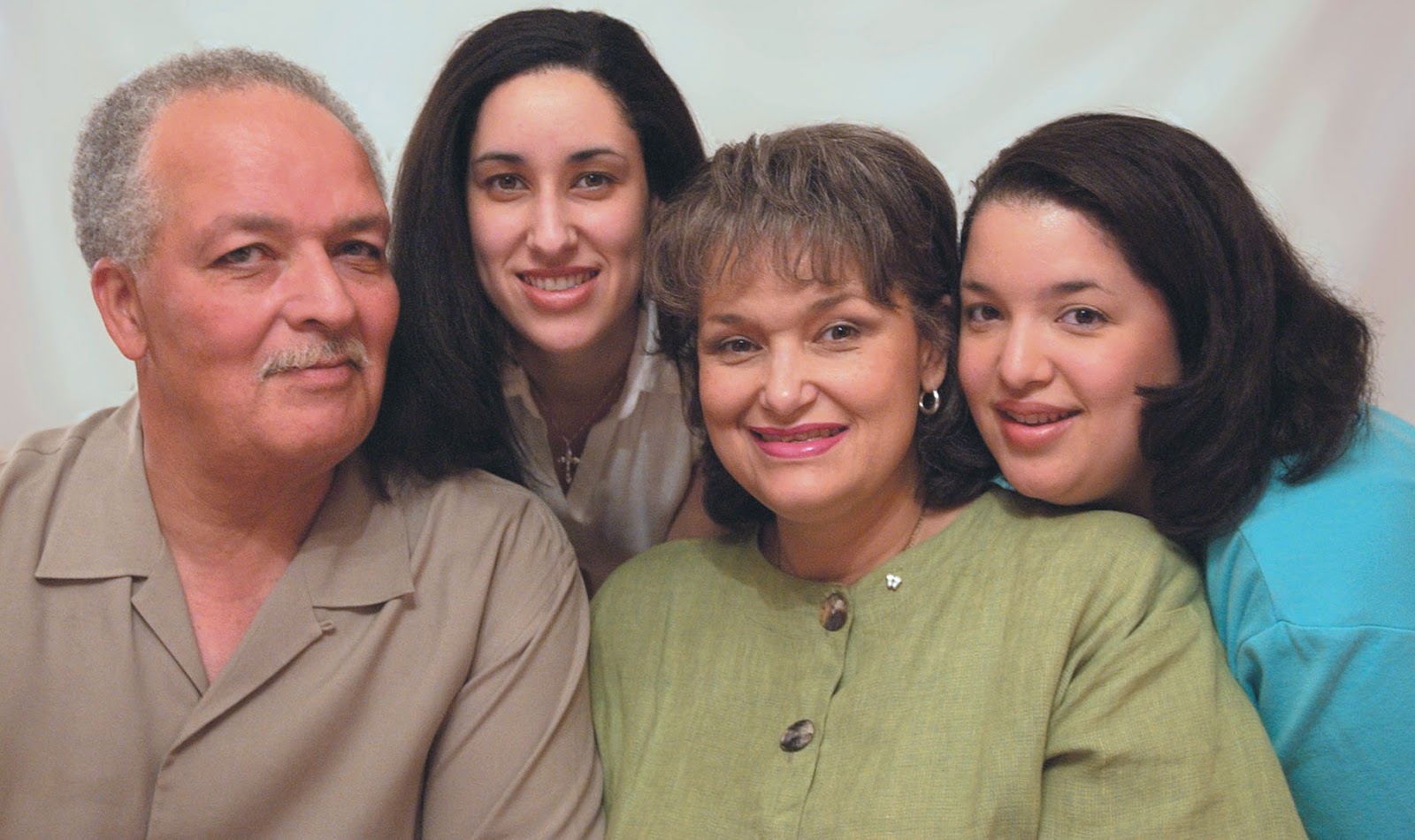 |
| Ralph Gaillard Sr., Courtney Gaillard, Mary Gaillard, Nicolle Gaillard |
My mother has told the story about her mistaken identity some 30 years ago during a job interview in Chicago, where she is from. The job was about to be offered to her until the interviewer determined that my mother was “Negro.” She was quickly informed that “the job was no longer available.”
My aunt, who is light-skinned, has shared with me stories about how strangers would stop her and her infant daughter. Of course a fuss was to be made over the precious brown-skinned bundle, but people assumed my aunt was the child’s nanny. Some even asked if my cousin was adopted – simply because that baby in the stroller was a different complexion than her mother.
These and other stories make up my family history. Some are humorous and others are hurtful. We retell these stories and look back on them from a distance but with an awareness that more will be added to our memories.
My parents both nurtured and prepared us for the battles ahead where our race was concerned. We were taught to expect challenges and chastisement as a result of our complexion. Pride, not arrogance, was always to be remembered – pride in ourselves and in our family.
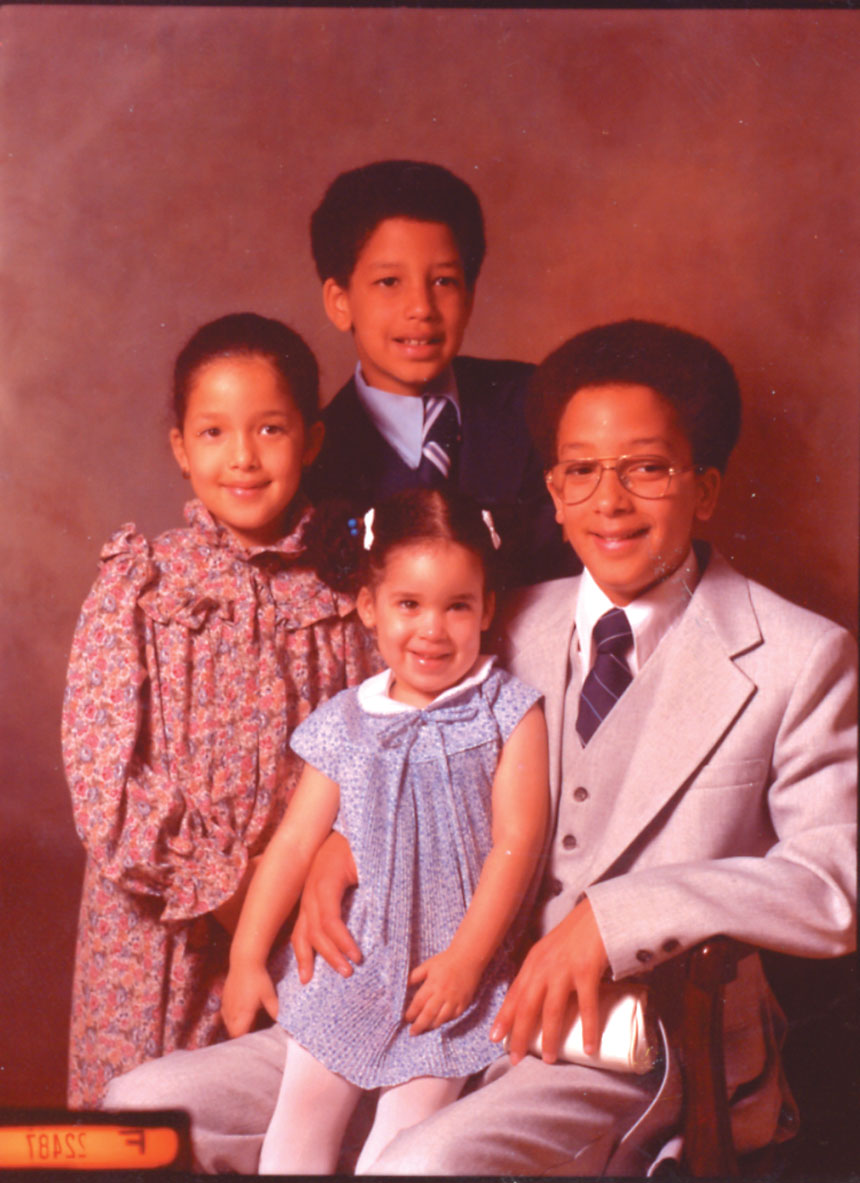 |
| Nicolle Gaillard, Courtney Gaillard, Sean Gaillard, Ralph Gaillard |
From the playground to the classroom to the boardroom I have encountered great reaction about my appearance, at times negative and cruel, from those around me.
I’ve been asked whether or not my “complexion” has been advantageous in my career thus far. And to my knowledge, no it hasn’t, because in past jobs most of my coworkers didn’t have a clue as to what my ethnic background was until I’d spent several weeks on the job. After two months on my last job at a magazine in Charlotte, a coworker felt comfortable enough to admit that she thought I was Egyptian when I showed up for my first day of work.
Most people, both black and white, often respond with shock and disbelief upon learning that I am black. I’ve been mistaken for Greek, Italian, Egyptian, Portuguese, Puerto Rican, Middle Eastern and more. Racial slurs and jokes have been spoken in my presence by whites who weren’t aware that they were in “mixed company.”
I also have been asked whether I have ever “passed” for white or whether or not I would ever consider doing so. The answer to that question every time is unequivo-
cally no. While passing for white is a lifestyle some blacks have chosen for various reasons, it simply was not a desired option for me. The way I see it is you can’t deny genetics, whether they are evident on the outside or not.
I’m accustomed to explaining and defending my ethnic background to all kinds of people. Countless times my complexion has been the brunt of a joke by a brother
or sister whose punch line typically ends with a reference to my being a “white girl,” “high yellow,” “oreo,” “red bone,” “uppity,” “bourgeois,” etc. White people have even gleefully pointed out to me that they are “darker” than I am. Go figure.
While some people might consider these wisecracks about my appearance to be harmless humor – “just poking fun at the light-skinned girl,” I can’t help but won-
der if there is an underlying question about a standard of blackness they feel I might be lacking because of my complexion. I’ve been challenged by blacks and whites
alike, and in some cases I’ve been dared to “show my ID at the door” – meaning: prove that I’m “black enough” behind all of my fair skin. My dating, musical and food
preferences have been questioned in an attempt to figure out “how black I am.” Do you watch BET? Do you date black men? Do you like R&B music? Do you tan? The answer is yes to all of the above.
Kathleen Cross captured the black experience of folks like me in a 1990 issue of Ebony:
“My skin, my hair, my features are White, but my experience is not. Neither is it wholly Black … Although my skin color has often shielded me from being the target of White racism, it has also created for me one of the most painful of human conditions, a lifetime of being misperceived and initially rejected by my own people. This is not an indictment: it is simply a testimonial to the remnants of White racism that have divided, and continue to divide, the descendants of Africa in America.”
Cross could not have summed it up any better. I remain puzzled and intrigued by the black-on-black prejudice that permeates our community because of our differing skin tones.
But I have been subject to racism from whites, just like any other African American.
One of my earliest encounters with the name “nigger” came in my fourth-grade computer class. I remember a chubby Italian girl saying, “Shut up nigger!” to me after I came to the defense of a classmate whom she had been bullying. After class, I told my teacher what had happened, and then I told my older sister, Nicolle. The teacher reprimanded her, and Nicolle told her off. The girl was in tears before lunch period was
over.
My freshman year in college, I remember a white hall mate stopping me and asking, “Your parents don’t mind you dating black guys?”
I explained to her that no they didn’t mind it considering they are black too. She never asked about my dating life again.
Keith Maddox, an assistant professor of psychology at Tufts University, released a study last year titled “Cognitive Representations of African Americans: Re-exploring the Role of Skin Tone.” The study sheds some light on why skin tone bias exists in the black community because it revealed that black observers associate light skin tone with positive traits and dark skin tone with negative traits. It came as no surprise to me that stereotypes such as these exist, and I suppose it is the root of the color complex problem in the black community.
In Maddox’s opinion, this history of a negative reaction to light-skinned blacks from dark-skinned blacks is the result of white-black racism in general.
“I think it’s all a consequence of racism, of white racism towards other ethnic groups – darker ethnic groups for the most part – and I think the influence on racism trickles down to an effect of members within those groups,” said Maddox during a recent chat I had with him. “I think the idea of people making fun of (light-skinned blacks) and degrading them in some sense has to do with the idea of the need to aggress towards someone who has always been thought of as superior.”
I also recently talked with Earl Smith, a professor of sociology at Wake Forest University, who has many thoughts about the history of skin-tone stereotypes and
myths in and outside of the black community.
“We live in a society where white skin privileges are very valuable,” Smith said.
The topic of skin-tone prejudice in the black community is a sore subject and one that many would rather not address. Over the course of several articles, The Chronicle will explore the experiences of blacks who are subject to mistaken racial identity.
Crystal Thornton, whose broadcasting career has taken her from the Midwest to Eastern North Carolina, sat down and shared with me what life was like growing up in the shadow of a landmark civil rights case and becoming the wife of a Marine. Martha Clavelle, a native Californian, is a local case worker who grew up on the West Coast among a melting pot of people, and she recently talked with me about how she is adapting to life in the South. Both are black women who are often mistaken for other races. They will speak candidly about their lives, the questions and conflicts that have surrounded them. There are others like them who will share their experiences in the weeks to come, and experts who hopefully will shed new light on the subject.
I choose to highlight their experiences and mine as pieces of the fabric that makes up the black experience in this country. My intentions are not to place blame or invite sympathy but to simply share the different life journeys of people who are black like me. Some people may not relate to these stories and others may not agree. But I hope that all who read this series will catch a glimpse of what life is like for those of us who may look different from you but are more alike than you might believe.
 Light and All Write